



(re-posted from the elevator authority blog) Recently I ran across several websites totally devoted to people taking their picture in elevator mirrors. Some of the elevator selfies were sexy, some funny and some highly inappropriate. One set of photos were in the documentary style of a daily photograph, marking life one frame at a time, one elevator ride at a time. It is interesting that mirrors in the interior of elevators have become so fascinating to so many leading to just one question…
Believe it or not there is an old elevator legend about how mirrors were first put into use in cars. And placed in elevator lobbies too. The yarn is that the elevator in a certain high-rise building was slowing down with age and lack of attention. Instead of making needed repairs, the building owner looked to the brilliant mind of a psychology student that lived in the building for a solution (Ok…I know this will be addressed later in the blog but really???? You are that cheap????).
The student suggested a less expensive alternative TO ACTUAL REPAIRS by giving people something to do other than just standing and staring at a blank wall when waiting. Theoretically, this would make the time pass faster and make it seem as if the wait was much shorter. The result was the first mirror installed in an elevator and the lobby.
People have been straightening their ties, combing their hair, checking their zipper and entertaining themselves in those mirrors ever since.
It is a truism that much like a caged birds preening in front of a their reflection, people get distracted by their own image. The result is they don’t think of the slow ride to their destination. As people are want to do, that philosophy has been taken to the extreme and now distraction seems to be on steroids. It is beyond just looking at ourselves for entertainment. Now you can dance as you go up and down like in this elevator in Legoland that has a light show and disco music.
Ultimately, that story about the mirrors may or may not be true. I have looked for genuine sources and it seems that everyone claims the mirror idea was theirs first or that it was unique to them. There are versions of the tale from IBM, Penn State, Bucknell even some traditional elevator companies had a version of the story circulating around.
The real problem with the story however, is not the mirror or the disco ball as the case maybe. Yes, even I appreciate glaring in a mirror during an elevator ride to double check for broccoli in my teeth. But only if I’m all alone. The bigger problem is the premise that the elevator was running slow due to age or lack of attention and the mirror was a cheap work-around and not solving the real problem. Remember, we are transporting very important cargo…people. And putting a Band Aid on a potential maintenance problem is a really, really bad idea.
So, if your elevator is running slow get a real solution from an elevator expert. And try to avoid solving problems with a psychology major from the fourth floor! Here is a list of specific things that need to be checked out by a licensed elevator technician to improve performance if your elevator is running slow.
Eventually if the mechanical issues are not addressed it could cause a failure, leaving people stuck or worse. Keep in mind that depending on the type of the elevator and application it may just be slower. Or slower than you would like. Although no one likes a slow elevator, a smooth, quality ride is just as important. Besides you need time to take all those selfies.
If you have a project in mind just click the button below. We would love to consult with you and you can get you budget numbers in less than a day. Of course you can also call us anytime, and have a real conversation with an expert in the elevator industry. We are looking forward to talking to you.

6 Reasons Modular Quality Matters – We have all been frustrated by low quality. Items purchased in good faith sometimes seem to break before they come out of the box. Or once out of the box, they look or perform nothing like what was pictured or promised when we bought the item. Instead of being happy with the purchase, words like cheap and flimsy cross our lips, meaning that we have been had. The more expensive the item, the more remorse follows.
However, in the modular industry quality is high because we take an antiquated process where onsite construction is the norm and move it to a production facility. What was then built by various people, in various trades, in various conditions becomes an orchestrated symphony of production. Historically poor quality and high cost is moved to a factory where exact processes and standards can be measured and accomplished. The modular process takes various acts of individual quality to a habit of success. For instance, at the Modular Elevator Manufacturing (our commercial elevator supplier) facility, they produce hoistways that are always plumb and level. That is simply due to the factory processes that cannot be accomplished on the jobsite and it shows.

“Quality is not an act, it is a habit.”
Aristotle
As Aristotle said, “Quality is not an act, it is a habit.” And those habits are formalized into higher quality with modular manufacturing. In modular building you will never hear “close enough” or “I guess we will have to make it fit.” It is right every time, because the habits that produce quality are built in.
Unfortunately, there are outliers in some manufacturing facilities. Quality becomes just a slogan. If modular quality matters why do some not improve quality? Procedures are skipped, shoddy workmanship is allowed, new practices are slow to be adopted or worse continued tinkering and “problem solving” doesn’t allow for systems to work. In other words, if you have a team of problem solvers constantly changing the system in an unorganized fashion, the quality will undoubtedly suffer.
At TL Shield we use Modular Elevator Manufacturing for our modular elevators. They make sure changes to procedures are checked and double checked before becoming standard because modular quality matters. One person cannot just change something at a whim, even if it is generally a good idea. The procedure must likewise be changed with the whole team being aware of any alterations. That is where habits of quality are formed for the whole organization.
We agree with the Phil Crosby philosophy of quality and as a literal rocket scientist he knew a thing or two about it. He said, “Quality is the result of a carefully constructed cultural environment. It has to be the fabric of the organization, not part of the fabric.” Quality is not posters, or slogans or bright ideas that get used once and then forgotten.
For us quality is a top-down effort and philosophy emanating from senior leadership and permeating the organization at every level. That is true of Modular Elevator Manufacturing as well. Quality is crucial and should matter that much at every business. It does at Modular Elevator Manufacturing where they take quality seriously.
With that said here are the 6 reasons quality matters at MEM. There are probably more but these are some of theirs:
The entire premise of modular construction is that by instilling factory processes into the construction trade, the industry can produce a higher level of quality, faster and often at a reduced cost. That is what they do at MEM day in and day out. However, when slipshod practices and lack of experience infiltrate the market, quality declines. Then the premise of factory production being better comes under attack.
Whether due to ignorance, no experience or a desire to make a fast buck, when quality is ignored the reputation of the industry gets sullied. The result is a better process that produces a better product (safer, greener and faster) becomes more difficult for the consumer to accept. Who knows how many dollars, how much time and how much energy has been wasted. How many injuries could have been avoided? All due to a very small number of businesses that do not see quality as important.
That is why we do not think “close enough” is good enough. We know that low-quality has a cost to the industry, the customer and to safety. We strive for quality in all we do. Whether you need a multi-family unit elevator or one for a medical facility, an elevator for a retrofit project or new construction we provide a quality solution.
If you have tried other vertical transportation specialists in the past and found that the quality with modular elevator was not as promised, don’t give up. Instead give TL Shield a try. We live by the above list of 6 reasons that modular quality matters and so does MEM. You will not be sold a bill of goods for a fast buck, but instead you will find a partner providing quality you can count on.
If you have a project in mind just click the button below, we would love to consult with you and you can get you budget numbers in less than a day. Of course you can also call us anytime, and have a real conversation with an expert in the elevator industry. We are looking forward to talking to you.

People Stuck in the Elevator – It was storming pretty bad outside the hotel my wife and I were at. All day long red flag warnings were out on the beach, so we decided to stay at the hotel for supper. We were strolling towards the elevator as winds howled outside and I said, “You know, I’ve never been stuck in an elevator.” with a laugh. I pushed the button and she said, “Well you just jinxed us.”

Both of us chuckled a bit and then we heard the inviting and all too familiar “ding” as the doors opened and we stepped onboard. The doors swiftly closed behind us but then the lights flickered and we heard an unexpected clunk.
Obviously the power had been interrupted and as a result the elevators in the entire hotel came to a screeching halt. Not only that, but I am sure all sorts of services were interrupted throughout the property. As we stood there we both knew better than to panic, so we waited.
That episode got me to thinking, if I were in charge of the building what should be done? I write a lot about elevators, but I rarely write on what the building owner or property manager should do when the elevator thuds to a halt. Not that this happens often.
Elevators get stuck rarely in the United States and injuries are even rarer. Especially considering that elevators move nearly the entire world’s population or 10 billion passengers a week. There is the occasional power outage or mechanical problem, but statistically only 1 elevator ride in 12 million or so results is some kind of issue and when it does happen it is extremely minor in nature.
But, my mind could not help thinking about when you are in charge and people are getting stuck in the elevator. What should be done? So, I came up with a list of steps if it ever happens to you. Feel free to borrow or print any of this list and keep it for a reference or reminder. Just remember the most important thing is to make sure the passengers stay safe and you do what you can to get the elevator moving as quickly as possible.
One last thing, everyone on staff should know if you are the auto-dialed, priority call for the elevator car. Sometimes the emergency phones are programmed to contact the non-emergency police or fire department in the local jurisdiction. They can also be programmed to contact your elevator service company directly. No matter who is called automatically, it still does not relieve you of your obligations to the passengers. So find out what floor and open a dialog. It shows you care. Most importantly don’t let people just stand there wondering. If you do they will be thinking more of escape than waiting which is always a danger.
Fortunately for my wife and I the emergency was relatively brief unlike Nicolas White. He spent 41 hours trapped in an elevator. When the power came back on in our case, the elevator system was reset and we zoomed down to the lobby without a further care in the world. We enjoyed a great gourmet meal and had several fun conversation about getting stuck…
But we did take the stairs back to our room.
Sometimes our blog posts are not all about selling elevators, but issues like people getting stuck in the elevator. They are often about general information you might find useful. So, feel free to comment below, ask any elevator questions you would like or follow future blog posts by signing up. However, if you do have a need for an elevator and want to know a general budget number, just click below for a Fast Track number. Also click to take a virtual tour of our facility. You can see for yourself what it takes to produce the best commercial quality elevator that is set in place fully installed in less than four hours. In any case we love hearing from you!

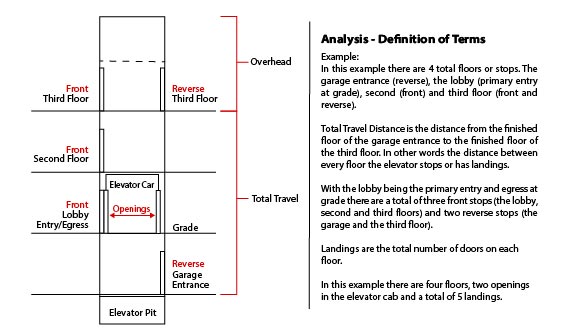
Elevator 101 is about the basics. See, being around elevators all the time can warp your perspective. You begin to think that everyone has a pretty high base knowledge of elevators and elevator lingo. We tend to forget that most people’s knowledge of elevators in the construction industry is limited to, “They are a pain in the rear end”. So, every once in a while it is a good idea to review what the basic terms mean. Reviewing this info is especially needed if you are going to be chatting with people in the elevator business about a specific project.
Overall there is too much jargon. Like talking to a doctor or lawyer, elevator people sometimes skip over things that are basic to them, but may confuse folks not immersed in the field. The intricacies of brain surgery or the meaning of habeas corpus (I think its a city in Texas), can easily pass us by and so can terms regarding elevators. We hope this will help.
So here is a list of basic terms that you should review, or bookmark before you talk with an elevator consultant, elevator sales person or even an elevator mechanic.
That above list is a good staring point. However, if you ever have a question feel free to call us whether you have the intention of buying a modular elevator or not. As geeky and weird as it sounds, we like talking about elevators.
Below is a handy diagram, a chart based on travel distance and some links.

Additionally if you want to know more about the modes of conveyance. Just click here for a full explanation. You can also click here for information on hydraulic units. You can also look at the dozens of articles we have available on our blog.
If you would like to know a bit about pricing for a project just click the button below to get a Fast Track Quote. But if you really want to know more about elevators, schedule a live, virtual tour of our factory. It is open to anyone with questions about elevators. We love showing off!

Project Management – The Change Problem / When it comes to the English language “change” is a neutral term and as a result can either be good or bad depending on the circumstance. On the good side an IT manager just reminded me that changing my password is a good thing. Especially true if your current password is “password” or “123456”. My very wise mother once told me to change my underwear routinely (just in case I get hit by a car). Every time daylight savings rolls around we change batteries in our smoke detectors. Good plan. And finally, change is a no brainer if a better idea comes along…like modular elevators instead of conventional. But that’s a blog post for another day.
On the other hand change can be not only bad, but very bad. New Coke was a bad change, at least to the devoted fans of the original. They were vindicated when New Coke was pulled from shelves. Remember when we had to start using Windows ME? And then Vista? Both spawned wild conspiracy theories of why they were a forced change. And I’m an old-timer so don’t even get me started on the designated hitter in baseball. Yuck!
Closer to home one of the changes that falls into the “bad” category is changing the project manger regarding an elevator project. It is a real bad idea to rotate through project leadership for a myriad of reasons. Like the old saying, “don’t changes horses in mid-stream” a project manager should be assigned and then remain on your team through out the project. They should start with the sale and progress through the installation process.
That means a consistent long-term commitment from the company as well as the individuals associated with the project. And when it comes to elevators that could be a long time. I don’t need to tell you that it is not unusual for an elevator to be ordered and it not be up and running for two years or more. Construction projects are not overnight endeavors so consistency is needed to make the elevator portion of the project go as smooth as possible.

Equally as important is that your assigned project manager is not a neophyte in the elevator business. You deal with enough bumbling fools everyday, why add another? With Modular Elevator Manufacturing we have team of highly qualified employees that know the elevator and construction industries inside and out unlike other companies. Longevity plus experience means you can trust our team over anyone else.
At MEM our process starts with a simple Fast Track quote. Next are formal quotes, drawings and engineering starting things off. The delivery date and production schedule are determined and come next. Verifying the site and pit dimensions (often skipped by others) followed by set, start up and final inspection. With MEM only one person is solely responsible for each of the steps of your project. So, for every step of that process you will have the same project manager. They will troubleshoot, give you updates you can trust and be there to hand the unit off to you when it is finished.
Many will downplay the crucial role of the project manager. They rotate through any number of them in the time between the sale and the final inspection. That means you as a customer you will be playing a guessing game. Who do I call when a challenges arise? How will I get the answers to my questions? Who will partner with me to keep my project on track?
If you are tired of the project manager merry-go-round, make one more change for better. Use MEM for your next project and see what a difference there is in the process and people at MEM. We are ready for any low or mid-rise building, from affordable housing to hospitals, parking garages to stadiums, schools to commercial structures. Quality elevators taking you higher.

Confusing Elevator Talk – In a recent Zoom conference with an architect, a simple question was posed, “Are elevators confusing on purpose?” The question made me stop in my tracks. This is the same thought that crossed my mind many times in doctor’s offices. Just replace the word “elevators” with “medicine”. It made me wonder, has our industry gotten to that point?
I’ll get to my answer in a minute but, first let me give you some context. Just prior to our online meeting my caller had just left another confab with a sales representative from a big elevator company. The salesperson was pressing for answers on a project regarding the elevator. That ball was being tossed between the architect who called me, the building owner and the construction manager. All three had questions before they pulled the trigger.
In the meeting it was discussed that the proposed elevator did not meet all the specs called out in the plans. So the architect had more queries. The owner of the building was fearful of hidden costs regarding the long-term maintenance and proprietary components. Finally the construction manager just wanted to know the particulars of the shaft and project timing. They went into the meeting thinking that they would get straightforward answers and clear their clouded minds.
Instead, none of the questions were answered in any understandable fashion and hence the Zoom call, the question and a little bit of venting.
It took a more than a couple seconds to gather my thoughts. And a few ummmhs to consider what was asked fully.
When my stammering ceased, my answer was an unsurprising yes and no. I went on the explain that of course elevators are confusing but, not on purpose. They are complex machines and usually the largest moving object in any building so very specific terms have been developed over time that means very specific things (here are a few examples). If you are outside of the elevator industry, sometimes those words can be complicated and muddy the conversation.
It is like eavesdropping on a team of doctors pondering possible treatments to an ailment. In all likelihood you would hear words that seem confusing, jargon stuffed paragraphs and three-letter abbreviations that make no sense to the vast majority of people outside of the medical profession. If I had to make a judgement call on healthcare issues based upon the inside discussions of a group physicians, I would most assuredly be confused. I am not a doctor and trust me that’s a good thing. So my limited knowledge would produce a poor outcome. That outcome would be paralysis of thought and real bad decision making.

Elevator chatter can likewise be the same. If you get in a room of elevator consultants, engineers and technicians and listen to what is being said, it would be the dizzying. Inside jokes would fly over your head and technical terms would land on deaf ears.
In the medical example, with a proper best bedside manner it all becomes clear when the doctor emerges from the circle of peers and speaks to the patient…or at least it should. My point is that elevator folks need to remember the audience when they are answering questions and discussing issues. Humility not hubris is needed and clear everyday language is the requirement not inside baseball jargon. This is not because our customers are too stupid understand! They are busy beyond belief with dozens of other building systems to manage and the elevator is just one piece. The burden is on us to clearly communicate.
But yes, elevators are complex in some ways and are confusing. They don’t need to be made confusing.

On the other hand, for years I have had the unenviable task of trying to explain elevators in simple terms. It can be done! The premise of modular elevators is that we can make high-quality commercial elevators easy to understand, purchase, set and start up. This can be hard as we are taking all the engineering of a modular tube-steel hoistway and putting all the elevator components inside the hoistway in a factory. Elevator complexity times two.
This manufacturing process must be done with the highest precision and quality assurance. The engineering must be spot on and the product must leave the facility ready to start up once up-righted at the site and the electricity is supplied. All this must be explained plainly and easily.
So, I know elevators can be made easy to understand because at MEM we have the chore of not only explaining the elevator but, the modular hoistway as well. It just seems that some in our industry gain some real pleasure in speaking over peoples heads. That arrogance leads to confusion.
Arrogance may just be the tip of the confusion iceberg however. I am convinced and so are a lot of other people in the industry that make it hard to understand intentionally. The purpose is to confuse the potential customer so selling up is easier.
Everyone that deals with old-fashioned, conventional elevators companies already knows this is at least true in part. What other motive can there be for hiding true costs? Why would they breeze over the obvious purpose of proprietary parts? What is the motivation behind the installation process being so overtly laborious and difficult to comprehend? How can the contract being filled with so many exclusions, ifs, wherefores and seemingly more fine print then a contract from Willy Wonka be explained?
One answer may lie in the words of the English philosopher and statesman who among other things developed the scientific method – Sir Francis Bacon. He is credited with saying that “Knowledge is power.” Unfortunately, there is a thought that withholding that knowledge from people will produce control and ultimately wealth. This is not a new notion.
The phrase “Knowledge is power” actually predates Bacon by centuries and contains a darker tone.
“Knowledge is power and it can command obedience. A man of knowledge during his lifetime can make people obey and follow him and he is praised and venerated after his death. Remember that knowledge is a ruler and wealth is its subject.”
Imam Ali – Nahj Al-Balagha (The Way of Eloquence) – Saying 147.5
That quote seems to be the credo of many in the elevator business. If confusion can reign and information withheld, those holding the knowledge can exploit those who don’t have it. Let me say as loudly as possible this is not necessarily a scheme or plot of an evil genius. It is an observation of human behavior. If you need an elevator, only a few have the knowledge to help and they are in control…until the advent of the modular elevator. By breaking away from the old, outmoded way producing and distributing elevators, we changed the way we talk about them as well.
So, there is an option if you have ever felt like asking the question, “Are elevators confusing on purpose?” and you are tired of confusing elevator talk. If you are not getting clear concise answers, contact us.
MEM has a dedicated force of sales representatives that are more knowledgeable than any other. We love selling elevators, but equally we love explaining them and answering questions. It is what we do; we honestly assess your needs, answer your questions and give you information in a way that will be less painful than a trip to the doctor’s office. If you have a project in mind, just click the button below to get started.

Just the Facts on Modular Elevators. I am old enough to remember the classic TV show Dragnet. Sargent Joe Friday played by Jack Webb and his partner Bill Gannon (Harry Morgan) of the Los Angeles Police Department would have a weekly crimefighting adventure.
There were two catch phrases in the show. The first was in the shows open, “The following story is true, the names have been changed to protect the innocent.” And the second and even more famous from Sgt. Friday, “Just the facts ma’am.” In truth the character never really said that at all. He said a much longer version “All we want are the facts, ma’am.” But that aside, “Just the facts.” became as famous as his dry, monotone delivery.
Sometimes we forget the facts are really all we need. Sure I spend some time being creative on the blog and looking for ways for the info to stick, but in reality an elevator purchase needs to be based on facts. This is especially true if the facts are in your favor like in the case of modular elevators and the modular industry as a whole.
So below are just the facts on modular elevators and buildings. Look them over, check out what I am saying and then you can decide if modular is right for your next project.
First, an important definition. Modular construction is, “A process in which a building is constructed off-site, under controlled plant conditions, using the same materials and designing to the same codes and standards as conventionally built facilities – but in about half the time. The buildings are produced in ‘modules’ that, when put together on site, reflect the identical design intent and specifications of the most sophisticated site-built facility – without compromise.” That is from the Modular Building Institute the leading non-profit trade association serving modular construction.
To boil the definition down, modular construction is a combination of modular units (in our case a modular elevator) that results in just as high a quality (if not more so) that you would find in stick-built or site-built projects. The components are the same or better with the only difference being a modular unit is manufactured with more exacting standards, closer scrutiny and more quality control. Yet it is completed much faster.
The process overall is faster as a factory can produce a unit faster than it can be built from scratch on site, but faster as well due to the time schedule of the entire build.

While prep work is being done the modules are being completed and readied for shipment.
The modular units can be almost any component of a multi-family buildings, hotel, school, office building or medical facility. Are you building an apartment complex? Modular can produce the entire living space including kitchens and bathrooms, common areas and of course elevators.
Do you need a medical office with a lab, exam rooms, office space, waiting areas and even bathrooms? It can all be modular. If you need to have multiple stories, the elevator from MEM is modular too. This process completely takes the elevator off the critical path.
With that said, let’s look at “Just the Facts.”
Just look at the facts on modular elevators in a way that would make Joe Friday proud and see that modular is the best solution for almost any project. But remember that modular elevators do not need to be in a modular only project! Modular elevators offer great benefits to any building project. To check things out more feel free to ask questions and examine the possibilities. The next step is to contact us for more information or for pricing on a modular solution. Just click the button below for a Fast Track budget number.

This blog post contains my personal cheat sheet or guide of determining the number of elevators per building. Whether you are an architect or a building owner these rules or thoughts are important to consider and apply, but are not hard and fast dictates. You get enough of that from the building code. They are however considerations based on experience.
With that said, keep in mind that the number of elevators per building has long been debated and argued, discussed and researched. Friendly forces on a project often work in opposition when deciding on the number. Initial installation and long-term maintenance costs are the concern of the building owner. The architect may be thinking about the traffic flow or the aesthetic. Finally, the code contains rules that must be followed.
These three forces and others must be melded into one decision and I hope this list can help explain or enlighten.
Lastly, a word about the list. It was developed over several years from all sorts of sources, from online white papers to personal conversations with architects, consultants and others. I supply the list when asked by anyone and have done so for years, however, today I am willing to share this information with you to better assist in answering the important question, how many elevators does my building need?
Keep in mind the number is not just a function of simple math, that would make this easy. But instead, it has to be based on a lot of information including the type of building to the expected traffic patterns.
Complicating this effort is that you may not know crucial information when still in the planning stages. But, you need to make a decision or there you will remain. So, to get the ball rolling you need to clearly think about the following questions. After the questions will be my general guidelines. Consider the items listed below to help sharpen your focus on the actual need.
The answers to those questions will guide you in your choice. Just remember your ultimate goal is to…provide the most cost effective elevator service to the greatest number of occupants, with the lowest possible wait times, when traffic is at its highest, to allow flow for the passengers as rapidly as possible.
With all that up front, here are the promised general guidelines or rough estimates for the number of elevators you need, based upon the type of building that you are considering.
Keep in mind that these numbers can and will change based upon many factors including current affairs. I change these considerations often and most recently did so based upon some issues in dealing with Covid-19. Based upon usage, infectious diseases and technology developed, I am sure the list will change again in the near future. On a side note, in use and in development are elevators with foot pedals, or no touch buttons. We may see a jump forward in technology in the medical field especially. Self-disinfecting elevators may need further development.
Remember to be thoughtful, ask plenty of questions and if you need the help contact a qualified consultant. Elevators per building can be tricky. So, if you have a project in mind and want to ask questions feel free to contact us at your convenience. We will always discuss elevators in general as a service. However of course, for thumbnail pricing for your project just click the Fast Track button below so we can help take you to a higher level.

For years Modular Elevator Manufacturing has been educating the public on elevators in general and the benefits of hydraulic elevators specifically. Hydraulic elevators are often times the absolutely best option for vertical travel, especially when it comes to low-rise applications. However, we have not spent an inordinate amount of time discussing many of the drawbacks. That is because there are very few and generally well understood. However, it has come to our attention that some of these drawback have taken on a life of their own and now live on in near mythic proportions.
So in this short article we are going to address the ups and downs of the hydraulic elevator, dispel myths and shed some light. This is not a sales pitch! After all you can buy a high-quality, commercial hydraulic elevator from any number of companies. We look at this article as a help to those that are truly curious about the best elevator for their current or future elevator project.
To keep me organized and to keep from jumping all over the place, I will address each point listed below. These are the largest complaints that many have about hydraulic elevators:
Believe it or not, there is merit to some of the claims made above, but the explanations are often ignored and this has led to more than one exaggeration. That begs the question, why would one perpetuate a misleading claim? I hate to say it, but sales and profit motives are usually big factors. If more money can be made, why sweat the small things like the truth and developing a reputation over time. After all, the elevator industry has such a stellar reputation, why damage it for a few dollars? Just kidding on the reputation crack. One of the biggest battles we face as an elevator manufacturer is the overall reputation of the industry as a whole.
Ask nearly any general contractor, building owner or architect and they will affirm they dislike the elevator business. In my experience and when doing independent research I have personally heard elevator companies described as bullies, untruthful, unreliable, unresponsive and overpriced. Do any of those descriptive terms surprise you? Unfortunately, probably not. So let’s just say that profit motives are powerful and can lead to some generalizations and exaggerations. But more than that, in the late 1990’s a new product was introduced to the American market. The MRL (machine room-less) traction elevator was rolled out with tons of fanfare and major investment from big elevator companies.
Logically, for that investment to payoff significant downward pressure was applied to sell up MRLs. Incentives were created, promises were made and poor comparisons were projected. Those sometimes false comparisons still ruminate in the minds of many. This coupled with ignoring hydraulic elevator technological improvements leads to a misunderstanding of facts and benefits. But let’s get to the list.
The first common complaint is that hydraulic elevators cost too much. Not necessarily in the upfront investment in installation, but in the Life Cycle Cost or LCC. The initial cost of a hydraulic unit runs around 35% less that a traction MRL. Not only is that true of pricing at Modular Elevator Manufacturing, but across the board, but what about maintenance and electricity? How does hydraulic stack up against MRL traction?
This question was answered by a study from of all places Thyssenkrupp. They were so interested in this question that they commissioned a report and then published its findings in a blog. The answer may surprise you. They found the following:

“We conducted Life Cycle Costing (LCC) research on low-rise elevators to help customers understand their economic and environmental impacts. LCC looks at the costs involved with a product or service over its entire lifetime. The study showed that over 25 years, the cost to maintain three-stop traction MRL is $173k compared to the same hydraulic MRL which cost $91k.”
Myths about Low-Rise Elevators Means Realistic Costs to Building Owners – Tetley-Scott 2014
Keep in mind that is the cost to maintain the elevator, not buying it and install it as well. That is a stunning admission. They are in basic terms saying that an MRL traction is, give or take, seven grand out of your pocket every year when a hydraulic is only three thousand-seven hundred. That is for the same travel distance and same number of stops. Cost wise hydraulic is the only logical choice. This is especially true when you add in the initial investment cost.
Regarding electricity, the same blog post points out, “In fact, a 2,500 lb. elevator, traveling a single floor (12 feet) at 100 fpm (feet per minute) and operates 100 runs a day, does not even use $600 worth of energy in an entire year. So assuming the hydraulic uses more energy than traction, you could have a differential of perhaps just $150 a year in energy cost.” In other words, in the whole picture, although a hydraulic elevator may use more electricity in a year, it is negligible to say the least.
It is an old canard that hydraulic elevators use significantly more energy than a traction. If it were true, we would produce counter-weighted hydraulic systems. It would be easy enough to do, but who on earth would pay so much up front and then have a more additional maintenance costs of weights and ropes? They make no sense because the electric cost is so low and going down every year as efficiency in hydraulic pumps and motors increase.
This is no old myth. When hydraulic elevator were first installed there were a couple of factors that made them less green than their traction counterparts. The hydraulic fluid used was not bio-degradable and the oil was in a jack underground where leaking could not be effectively monitored. It was a time bomb of sorts as rust and corrosion slowly wore away at the hole lining, jack and bulkhead. The seals were more prone to failure and the drips turned into steady streams of lost fluid.
There are still hundreds of these old systems in place today. And they are either, by some miracle leak free, they are not being routinely checked for oil loss or the person paying the bills would rather buy a five-gallon bucket of oil every quarter than have the jack pulled and replaced.
But things have changed. In many applications you can use above ground jacks and better materials are available when an in ground jack is needed. Generally, PVC filled with sand is in the hole and then the jack is inside the PVC. If installed properly there should be no leaking at all.
Also, the elevator code has recognized the need for improved environmental awareness. If the code is followed, environmental issues should be non-existent to rare. If there are any problems or accidents of an environmental nature it is more than likely due to unqualified installers. Current technology affords jack leak monitoring systems and all the jack components are better than in years past. This coupled with good maintenance and record keeping should significantly reduce any hydraulic fluid escaping into the ground.
But what if it does? Good question. The last line of defense are interceptors for spilled oil that separate the oil from water protecting the environment against leakage. And also you now have the choice of many bio-degradable hydraulic fluids formulated for elevators. Oil replacement and additional testing is necessary so the elevator technician needs to know of this choice. But there is no real need to worry about leaks if you don’t want to with improved rules and technology.
Okay hydraulic elevators are slower. But does that matter? I really could write an entire article on this subject…as a matter of fact I already have. You can check it out here. You can read it if you are really interested, but for everyone else let me cut the the chase. Speed is really needed if you are going over six or seven stories for sure and maybe a wanted convenience you would like going over four or five stories. But for anything below that you are not getting your money’s worth.
The reason is due to limits of the human body and how fast an elevator can get to top speed and still be a comfortable ride. If you are traveling just 30 or so feet you would just barely get to top speed before starting to slow down again for the next stop. Top speed is rarely to never hit in a typical three stop elevator. Think about it, you would be thrown to the floor or pasted to the ceiling if you traveled to top speed any faster. So yes, hydraulic elevators are slower, but for low-rise applications it is not that important at all. Yet everyday we send out Fast Track budget numbers to people that are convinced they need a jet pack for 10′ to 20′ feet of travel. The need for that much speed does not exist.
To increase speed at a lower cost a roped hydraulic is a great option if you are going over three or four stories. It combines a hydraulic system with a pulley wheel at the top of the jack. This speeds up the elevator and increases the total height of travel.
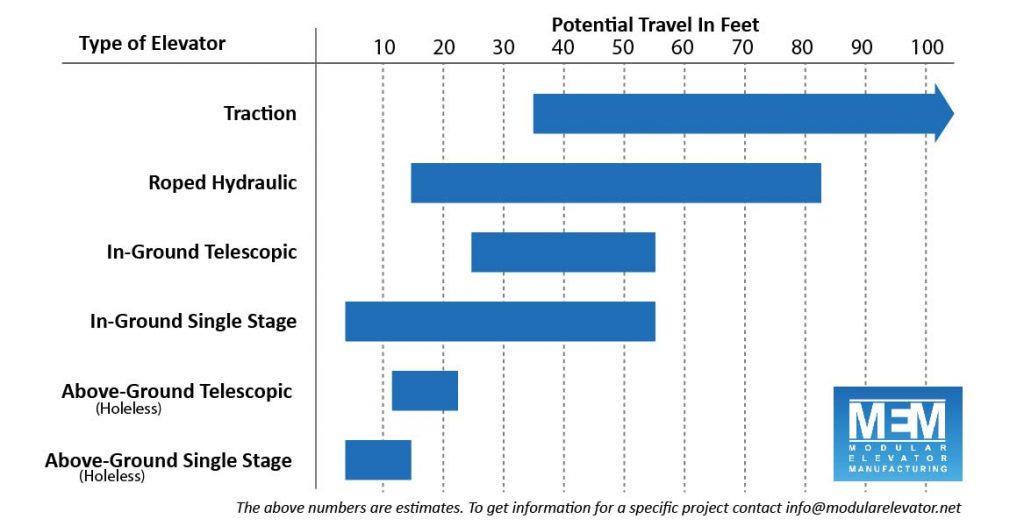
Although limited, hydraulic elevators may go higher than you thought. Two or three stops are just the beginning. I have seen hydraulic elevators installed up to six stops. That is with over 60′ of travel! The chart below shows a comparison of what MEM can provide and associated travel. Keep in mind these are only general numbers.
The important thing is to weigh all the options available and not make any snap decisions without some research. For building owners and managers, that may mean asking some hard questions of your team and comparing costs to benefits. For the architect it may mean thinking outside of the elevator cab. Look for a better technology, before you drop in the same footprint. For the GC you might need to call and ask questions about how other alternatives can make your job easier, not harder when it comes to the elevator installation.
It is important that, when looking at the elevator alternatives, you do not just listen to sales pitches. Doing so will cost you significantly more in both the short and long term. I hope this article makes clear that traction elevators are not a proper alternative for two and three stop projects accept under certain circumstances. Also, hydraulic elevators up to five stories need to be considered. Based on cost and use you may find a hydraulic as the best alternative. Just take a look at the facts, determine your needs, and choose wisely.
You will be keeping your elevator for a long time so seek independent voices. MEM can be a great resource or a qualified elevator consultant. We won’t say one is better than the rest just for a sale. Just find the proper and most applicable mode-of-conveyance for the right application.
If you have a project in mind, or questions about this article or our line of manufactured elevators feel free to contact us for Fast Track budget numbers. Our knowledgeable team will happily advise you on the most effective and beneficial mode-of-conveyance for you and your project. We can provide budgetary numbers in 24 hours.

