


MEM News. Modular Elevator Manufacturing is in the news again. Mark Madler from the San Fernando Business Journal conducted an in depth interview with our vice president of sales, Hugo Beltran and they discussed the significant growth in nationwide sales since the company made the move to increase distribution earlier this year.
Here is a link to the story here. Or download it below.
Modular elevators are the future for any low and mid-rise applications and the modular industry provides significant benefits to any project. It is a faster, greener and smarter way to build. However, without quality the benefits of modular dissipate quickly. That is why MEM is the leader in the modular elevator industry. MEM understands that quality is the biggest contributor to market growth and why they are so much different than others.
If you have a project that requires a quality elevator completed faster, greener and smarter, click the button below. With just general information we can provide a quote in less than a day. MEM is quality elevators taking you higher.

Just the Facts on Modular Elevators. I am old enough to remember the classic TV show Dragnet. Sargent Joe Friday played by Jack Webb and his partner Bill Gannon (Harry Morgan) of the Los Angeles Police Department would have a weekly crimefighting adventure.
There were two catch phrases in the show. The first was in the shows open, “The following story is true, the names have been changed to protect the innocent.” And the second and even more famous from Sgt. Friday, “Just the facts ma’am.” In truth the character never really said that at all. He said a much longer version “All we want are the facts, ma’am.” But that aside, “Just the facts.” became as famous as his dry, monotone delivery.
Sometimes we forget the facts are really all we need. Sure I spend some time being creative on the blog and looking for ways for the info to stick, but in reality an elevator purchase needs to be based on facts. This is especially true if the facts are in your favor like in the case of modular elevators and the modular industry as a whole.
So below are just the facts on modular elevators and buildings. Look them over, check out what I am saying and then you can decide if modular is right for your next project.
First, an important definition. Modular construction is, “A process in which a building is constructed off-site, under controlled plant conditions, using the same materials and designing to the same codes and standards as conventionally built facilities – but in about half the time. The buildings are produced in ‘modules’ that, when put together on site, reflect the identical design intent and specifications of the most sophisticated site-built facility – without compromise.” That is from the Modular Building Institute the leading non-profit trade association serving modular construction.
To boil the definition down, modular construction is a combination of modular units (in our case a modular elevator) that results in just as high a quality (if not more so) that you would find in stick-built or site-built projects. The components are the same or better with the only difference being a modular unit is manufactured with more exacting standards, closer scrutiny and more quality control. Yet it is completed much faster.
The process overall is faster as a factory can produce a unit faster than it can be built from scratch on site, but faster as well due to the time schedule of the entire build.

While prep work is being done the modules are being completed and readied for shipment.
The modular units can be almost any component of a multi-family buildings, hotel, school, office building or medical facility. Are you building an apartment complex? Modular can produce the entire living space including kitchens and bathrooms, common areas and of course elevators.
Do you need a medical office with a lab, exam rooms, office space, waiting areas and even bathrooms? It can all be modular. If you need to have multiple stories, the elevator from MEM is modular too. This process completely takes the elevator off the critical path.
With that said, let’s look at “Just the Facts.”
Just look at the facts on modular elevators in a way that would make Joe Friday proud and see that modular is the best solution for almost any project. But remember that modular elevators do not need to be in a modular only project! Modular elevators offer great benefits to any building project. To check things out more feel free to ask questions and examine the possibilities. The next step is to contact us for more information or for pricing on a modular solution. Just click the button below for a Fast Track budget number.

SEPT 23, 2020/Westlake, CA – Modular Elevator Manufacturing (MEM) has added new staff to increase capacity and meet growing demand. As the modular elevator manufacturer continues to increase its market share nationwide, a new IT manager, national territory manager, two new elevator technician trainees and elevator technician helper have been added. In addition, a marketing firm with national experience was added to the team.
Duncan McEwan, IT Manager will work to centralize the IT support and system management, providing a more consistent user experience for customers and staff though the improved integration of the IT systems. He previously worked as an IT Administrator for the Television Academy providing support for all of their activities, most notably, the Creative Arts and Primetime Emmy Awards.
This involved supporting the online voting process and hosting IT and audio/visual needs for the various panels that convene each year to vote for categories of Emmy Awards. He also provided the network access, both WiFi and hard wired for the press core at the Emmys Awards, including the WiFi for the Red Carpet. At MEM his experience will improve the customer experience and information flow.
Ken Grider, National Territory Manager brings his commercial and residential construction experience and modular elevator knowledge as well as a proven ability to drive business growth and increase market awareness. More than that, Ken is creative and a strategic thinker with strong communication skills and a strong desire to help customers find the best solution to MEM.
Jesse Ochoa and Jose Perez have been added to increase the ranks of licensed elevator technicians as they complete their training and Jose Galvin has been added as an elevator technician helper. This will ensure that as the demand for modular elevators continues to increase, MEM will maintain the largest and most qualified staff in the modular industry.
Additionally, to assist with the new national effort a St. Louis, Missouri area marketing firm has been engaged. Speiro Communications will help direct the effort to increase an already growing market share. Providing true quality and the most experience in the industry will be the cornerstones going forward.
California based MEM produces elevators from simple ADA compliant models to freight elevators. They are routinely sold in several types of buildings including educational, hospitality, healthcare, multi-family, commercial, storage and parking structures. The elevators are used in retrofit projects as well as new construction. For more information on MEM go to at modualrelevator.com.
If you would like to put the MEM team to work, click the link below to receive a Fast Track quote.

Elevator with a faster ROI. It started out as a simple conversation with a major investor (name withheld intentionally) with a hotel company at a construction job site. I was walking around with a camera around my neck and taking some video. As the crane roared in the background, he leaned over in my general direction and shouted, “Who are you here with?”
I pointed to the modular elevator being suspended by the crane and I said with equal energy back to him, “The elevator company.”

A broad smile crossed his face and he said a curious thing that I was not in the least prepared for, “Thank you.” he shouted.
With an inquisitive look I stammered back, “Your welcome?” He nodded still sporting that wide grin.
It then occurred to me that I had a very rare chance to speak directly to a major investor in the project. We talk constantly to architects, general contractors, elevator contractors, project managers and a whole host of others with various responsibilities, but it was rare to actually be at the job site and speak one on one with an investor. Our paths just don’t cross.
It is not rare that they check up on progress with on site visits, but as the elevator hoistway with all the components pre-installed takes only a couple hours to set it is rare our paths cross. And if he had the time, I would love to ask a few questions about his impressions and what stood out about the modular elevator. So I picked out his SUV…not difficult to do in the construction crew parking lot and camped out near there as I shot more video.
Eventually he appeared from the construction trailer and I asked him for a moment. He said he had a second or two he could spare, so I wasted no time. I introduced myself and asked what he thought.
Now, usually when you see a huge 15 ton object being swung into place at a job site on the end of a crane hook, people take a moment to look up and see what is going on and gaze in amazement. At a recent job in San Diego, faces dotted the windows in an adjacent building so onlookers could to get a peek of the elevator being lifted into place.
I have seen the curious have to be held behind yellow caution tape or with one project, a row of lawn chairs popped up across from a church getting its first elevator. So I imagined the gentleman I was speaking with would talk about how impressive the elevator looked being lifted and placed. I couldn’t have been more wrong.
“Its all about the ROI.” he said. “The return on investment is what excites me most about your product.”
He could tell by my stunned look I needed a further explanation. So he went on to say that with the modular elevator unit in his estimation, nearly 6 month could be trimmed off the total time usually allotted for the build. This significantly reduces the general construction costs. Because he made more money, faster from his perspective, he loved the MEM modular elevator.
He quickly laid out that with modular, while the ground is prepped and the concrete poured, the elevator and hoistway are being produced in a factory. So there is never a delay in hoistway construction. Bad weather doesn’t matter. The elevator can be set any time of year and problems with labor to build the hoistway are non-existent. Everything is done off site.
But beyond that, when the power is available they can use the elevator as a construction elevator. That saves even more money on the project. Finally, he indicated that there is no delay in getting it up and running. There is no need for extra space, extra parking, or having more people onsite stepping over each other. The elevator crew shows up for about a week and voila the elevator functions as intended, not months like usual. The elevator is totally off the critical path and the hotel can be occupied faster.
He summed it all up by saying, “That is why we love your product. An elevator is an elevator to me. Push the button and it goes up. But yours gives a faster return on my investment than any other. And no other elevator can change the timeline on an entire project for the positive.”
With that, as quickly as our impromptu meeting began it ended. He jumped into his SUV and sped off to the next project three states away. However, he gave me a lot to think about. Although an elevator with a faster ROI seemed important before the chance encounter, it now means even more to me.
My hope is investors and building owners that would like to shave time off of a project would click to find out more. They will ultimately realize a faster ROI on a building project if they do. We would love to talk to you about your project and how we can be a part of your solution. Modular Elevator Manufacturing – quality elevators taking you to a higher level.

“Can we get entrances at the front and side of an elevator?” was the question. Ask this question and you will get one of two answers from most elevator manufacturers… “No” or “Yes, but it’s going to be very expensive”. Unfortunately, due to the design integrity, elevator proximity and building layout a corner post elevator was a must. Yet no one offered the flexibility architects deserve and need.
Until the builder suggested they contact Modular Elevator Manufacturing. The architect explained what was required and the elevator design got underway. You can see the modular elevator in the above video first making an appearance at about the 1:53 mark. It is the tall rectangular box that is covered in a white protective shrink wrap. You may be thinking “it doesn’t look like an engineering marvel”. The Project Foreman was thinking the same thing since the elevator crew was done setting the elevator so quickly. But, under that shrink wrap is a complete, ready to run, commercial elevator with front and side entrances. To an elevator aficionado, an engineering marvel…to this project team…a “problem solved”.
We get to hear “problem solved” a lot at Modular Elevator Manufacturing. Henry Ford said: “If you always do what you’ve always done, you’ll always get what you’ve always got.” Even though, for the most part, we build a box we are not afraid to think outside of it.
We take a lot of pride in the fact that we are often called upon to be the solution. Here are a few examples of projects where we have been asked to provide unique solutions to project challenges. In each situation we worked with the architect, general contractor and building owners or investors closely.

Each of the jobs listed on the MEM Project Reference Sheet are unique and they all presented their own challenges. Many multi-story projects do. Creating and designing them takes significant effort. Then moving them from concept to finished job takes a team that understands the stresses.
Because we have a long track record of success and decades of experience in the elevator/building trades we know the pressure points. That means we can help lift many of the burdens that traditional elevator companies seem to ignore.
We hope that you appreciate our efforts by recognizing that the flexibility architects deserve, should be built into every job.
That does not mean that everything we do is a stand-alone effort with a singular use. We will custom engineer elevators to meet a specific need, but more commonly our elevators are used repetitively across a common building design. Specifically in multi-family units or hotel designs that are replicated, we are a perfect solution. If you know your total travel, basic footprint and traffic needs we can put together a repeatable package specifically for you. We can even duplex or bank elevators easily. Fast, easy placement is a snap and you can be assured that all your projects will have consistent finishes, floor plans and engineering built in.
But don’t think that you need to place an order for 100 elevators to take advantage of the true benefits of modular manufacturing. Keep in mind we are big supporters of the modular manufacturing industry! Our elevator are modular, but they can be used in either conventionally-built or modular applications. We know often the market dictates the timing of needs and other factors as well. The elevator is just one aspect of many that make a project work. Keeping all the balls in the air at once is a challenge.
That is why we provide flexibility when needing several elevators whether for multiple projects starting immediately or jobs that will be spaced by months or years. The bottom line is that we have consistency and a long track record you can trust and we will be ready when you are ready.
Flexibility architects deserve is not just a catch phrase or slogan for us. We provide that on every project we work on. Whether you order dozens of modular elevators over a decade or you have a specific problem that needs some out of the box thinking come to us for solutions. We are more than willing to listen, assess and provide the best elevator system for any low and mid-rise application. Modular Elevator Manufacturing – quality elevators taking you to a higher level.

We are in the news!
Los Angeles, CA. July 23, 2020 — MEM Doubles Factory. Modular Elevator Manufacturing (MEM) has now doubled its production facility. This is in response to a significant increase in sales growth as a result of a new nationwide marketing and sales campaign. Interest in the high-quality commercial modular elevator product is way up due to the national strategy being employed since the beginning of 2020 and the uniqueness of the product itself. MEM elevators are now scheduled to ship from the Los Angeles based company to as far away as New York City and projects are being considered at all points in between.
This dramatic growth in the modular elevator market is despite the outbreak of the Covid-19 virus for many reasons. First, modular elevators set in less than a day. Then they are started up in less than a week in most cases. That means fewer people coming and going from the construction job-site, potentially meaning less spread. This contrasts with the old way elevators have been built. That method requires a steady stream of workers showing up for months at a time and working closely together.
With conventional elevators, a hoistway is constructed first, and then all the components are shipped to the job-site and installed. This can be a painstaking and dangerous process as it all takes place in a cramped hoistway. Now with social distancing a concern, the troop of elevator mechanics, construction workers and helpers required for the conventional method may mean a higher risk for spread.
Second, the modular elevator is manufactured in a controlled environment. Safety protocols can be employed easily That is not the case at most project sites. Social distancing and sanitizing the work area can be easily managed. An additional plus of the factory controlled environment is that there is increased elevator and hoistway quality. The manufactured hoistway is a tough steel frame, sheathed in drywall. All of the elevator components are already installed in a controlled environment. They arrive at the project location, are craned into place, and then started up when power is available.
Lastly, project completion overall is much faster when modular is used. It takes the elevator off the critical path during construction. The job can be completed faster leading to a safer building environment.
All of the benefits makes the sales process more of an education than a high-pressure sales pitch. According to Vice President of Sales, Hugo Beltran “The product is perfect for the times in which we are living. They are high-quality commercial elevators set and started up faster than conventional elevators. This means fewer people at the job-site. That makes modular elevators from MEM greener, safer and smarter.”
He went on to say that education on the benefits is made easier due to the competitive pricing. “We are being selected as the elevator solution by our clients because of the investment. It is a better manufactured, higher quality product in line with general elevator pricing and the hoistway is included.”
At the newly enlarged production facility MEM produces elevators from simple ADA compliant models to freight elevators. They are routinely sold for several types of buildings including educational, hospitality, healthcare, multi-family, commercial, storage and parking structures. For more information on MEM go to at modualrelevator.com. See the article MEM Doubles Factory here.

Elevator installers and technicians need to know more than how to turn a wrench. As you all know, Modular Elevator Manufacturing (MEM) is now nationwide, so we are looking for the right kind of knowledgeable people with the desire for growth. We are lining up work across the United States and in Canada and it is opening up opportunities for businesses and individuals in the elevator industry.
There are two ways you can be a part of the ever-growing field of modular elevators:
It starts with filling out this simple questionnaire. We just need to know you are a licensed elevator technician, the jurisdictions you work in and your contact information. From there we will speak to you about any future opportunities.
As an overview, we will provide you with information you need to setup and startup an MEM product. We will also help you with knowing your time commitment to any project you bid and give you in person support as needed. Note we do not say install the elevator, but setup and start up. This is due to the traditional elevator installation takes place in the factory. The hoistway is completely wired, with doors, rails and even the cab installed when it arrives. That means there is significantly less time invested in each project. For a quick look at how fast a set can go, click the button below. Generally a fully installed elevator can be set in a couple hours.
Most importantly know that we are looking for a long-term relationship that we can build on together. We have a solid, high-quality product, unlike other modular elevator companies. The result is we are looking for solid, high-quality people to join with us.
As you understand, there can be a significant lag time between the quote and getting the job. But you will won’t have the future opportunity if you don’t get start today.
Go to this page for more information and for general expectations. If you already know of a project that might be a good fit, let us know by clicking the Fast Track Button below. We will supply you with pricing in 24 hours so you can provide it to your potential customer. Otherwise click below and fill out the simple application today.

For years Modular Elevator Manufacturing has been educating the public on elevators in general and the benefits of hydraulic elevators specifically. Hydraulic elevators are often times the absolutely best option for vertical travel, especially when it comes to low-rise applications. However, we have not spent an inordinate amount of time discussing many of the drawbacks. That is because there are very few and generally well understood. However, it has come to our attention that some of these drawback have taken on a life of their own and now live on in near mythic proportions.
So in this short article we are going to address the ups and downs of the hydraulic elevator, dispel myths and shed some light. This is not a sales pitch! After all you can buy a high-quality, commercial hydraulic elevator from any number of companies. We look at this article as a help to those that are truly curious about the best elevator for their current or future elevator project.
To keep me organized and to keep from jumping all over the place, I will address each point listed below. These are the largest complaints that many have about hydraulic elevators:
Believe it or not, there is merit to some of the claims made above, but the explanations are often ignored and this has led to more than one exaggeration. That begs the question, why would one perpetuate a misleading claim? I hate to say it, but sales and profit motives are usually big factors. If more money can be made, why sweat the small things like the truth and developing a reputation over time. After all, the elevator industry has such a stellar reputation, why damage it for a few dollars? Just kidding on the reputation crack. One of the biggest battles we face as an elevator manufacturer is the overall reputation of the industry as a whole.
Ask nearly any general contractor, building owner or architect and they will affirm they dislike the elevator business. In my experience and when doing independent research I have personally heard elevator companies described as bullies, untruthful, unreliable, unresponsive and overpriced. Do any of those descriptive terms surprise you? Unfortunately, probably not. So let’s just say that profit motives are powerful and can lead to some generalizations and exaggerations. But more than that, in the late 1990’s a new product was introduced to the American market. The MRL (machine room-less) traction elevator was rolled out with tons of fanfare and major investment from big elevator companies.
Logically, for that investment to payoff significant downward pressure was applied to sell up MRLs. Incentives were created, promises were made and poor comparisons were projected. Those sometimes false comparisons still ruminate in the minds of many. This coupled with ignoring hydraulic elevator technological improvements leads to a misunderstanding of facts and benefits. But let’s get to the list.
The first common complaint is that hydraulic elevators cost too much. Not necessarily in the upfront investment in installation, but in the Life Cycle Cost or LCC. The initial cost of a hydraulic unit runs around 35% less that a traction MRL. Not only is that true of pricing at Modular Elevator Manufacturing, but across the board, but what about maintenance and electricity? How does hydraulic stack up against MRL traction?
This question was answered by a study from of all places Thyssenkrupp. They were so interested in this question that they commissioned a report and then published its findings in a blog. The answer may surprise you. They found the following:

“We conducted Life Cycle Costing (LCC) research on low-rise elevators to help customers understand their economic and environmental impacts. LCC looks at the costs involved with a product or service over its entire lifetime. The study showed that over 25 years, the cost to maintain three-stop traction MRL is $173k compared to the same hydraulic MRL which cost $91k.”
Myths about Low-Rise Elevators Means Realistic Costs to Building Owners – Tetley-Scott 2014
Keep in mind that is the cost to maintain the elevator, not buying it and install it as well. That is a stunning admission. They are in basic terms saying that an MRL traction is, give or take, seven grand out of your pocket every year when a hydraulic is only three thousand-seven hundred. That is for the same travel distance and same number of stops. Cost wise hydraulic is the only logical choice. This is especially true when you add in the initial investment cost.
Regarding electricity, the same blog post points out, “In fact, a 2,500 lb. elevator, traveling a single floor (12 feet) at 100 fpm (feet per minute) and operates 100 runs a day, does not even use $600 worth of energy in an entire year. So assuming the hydraulic uses more energy than traction, you could have a differential of perhaps just $150 a year in energy cost.” In other words, in the whole picture, although a hydraulic elevator may use more electricity in a year, it is negligible to say the least.
It is an old canard that hydraulic elevators use significantly more energy than a traction. If it were true, we would produce counter-weighted hydraulic systems. It would be easy enough to do, but who on earth would pay so much up front and then have a more additional maintenance costs of weights and ropes? They make no sense because the electric cost is so low and going down every year as efficiency in hydraulic pumps and motors increase.
This is no old myth. When hydraulic elevator were first installed there were a couple of factors that made them less green than their traction counterparts. The hydraulic fluid used was not bio-degradable and the oil was in a jack underground where leaking could not be effectively monitored. It was a time bomb of sorts as rust and corrosion slowly wore away at the hole lining, jack and bulkhead. The seals were more prone to failure and the drips turned into steady streams of lost fluid.
There are still hundreds of these old systems in place today. And they are either, by some miracle leak free, they are not being routinely checked for oil loss or the person paying the bills would rather buy a five-gallon bucket of oil every quarter than have the jack pulled and replaced.
But things have changed. In many applications you can use above ground jacks and better materials are available when an in ground jack is needed. Generally, PVC filled with sand is in the hole and then the jack is inside the PVC. If installed properly there should be no leaking at all.
Also, the elevator code has recognized the need for improved environmental awareness. If the code is followed, environmental issues should be non-existent to rare. If there are any problems or accidents of an environmental nature it is more than likely due to unqualified installers. Current technology affords jack leak monitoring systems and all the jack components are better than in years past. This coupled with good maintenance and record keeping should significantly reduce any hydraulic fluid escaping into the ground.
But what if it does? Good question. The last line of defense are interceptors for spilled oil that separate the oil from water protecting the environment against leakage. And also you now have the choice of many bio-degradable hydraulic fluids formulated for elevators. Oil replacement and additional testing is necessary so the elevator technician needs to know of this choice. But there is no real need to worry about leaks if you don’t want to with improved rules and technology.
Okay hydraulic elevators are slower. But does that matter? I really could write an entire article on this subject…as a matter of fact I already have. You can check it out here. You can read it if you are really interested, but for everyone else let me cut the the chase. Speed is really needed if you are going over six or seven stories for sure and maybe a wanted convenience you would like going over four or five stories. But for anything below that you are not getting your money’s worth.
The reason is due to limits of the human body and how fast an elevator can get to top speed and still be a comfortable ride. If you are traveling just 30 or so feet you would just barely get to top speed before starting to slow down again for the next stop. Top speed is rarely to never hit in a typical three stop elevator. Think about it, you would be thrown to the floor or pasted to the ceiling if you traveled to top speed any faster. So yes, hydraulic elevators are slower, but for low-rise applications it is not that important at all. Yet everyday we send out Fast Track budget numbers to people that are convinced they need a jet pack for 10′ to 20′ feet of travel. The need for that much speed does not exist.
To increase speed at a lower cost a roped hydraulic is a great option if you are going over three or four stories. It combines a hydraulic system with a pulley wheel at the top of the jack. This speeds up the elevator and increases the total height of travel.
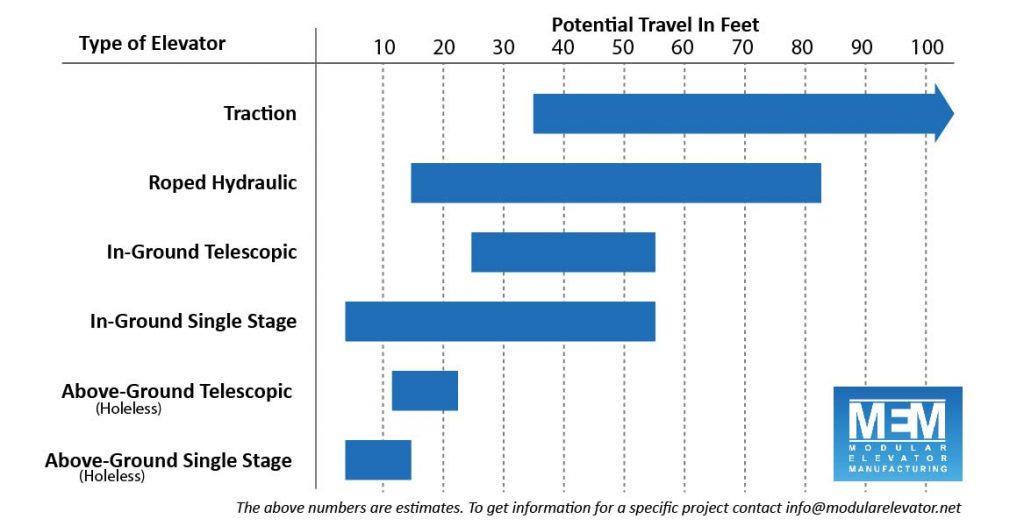
Although limited, hydraulic elevators may go higher than you thought. Two or three stops are just the beginning. I have seen hydraulic elevators installed up to six stops. That is with over 60′ of travel! The chart below shows a comparison of what MEM can provide and associated travel. Keep in mind these are only general numbers.
The important thing is to weigh all the options available and not make any snap decisions without some research. For building owners and managers, that may mean asking some hard questions of your team and comparing costs to benefits. For the architect it may mean thinking outside of the elevator cab. Look for a better technology, before you drop in the same footprint. For the GC you might need to call and ask questions about how other alternatives can make your job easier, not harder when it comes to the elevator installation.
It is important that, when looking at the elevator alternatives, you do not just listen to sales pitches. Doing so will cost you significantly more in both the short and long term. I hope this article makes clear that traction elevators are not a proper alternative for two and three stop projects accept under certain circumstances. Also, hydraulic elevators up to five stories need to be considered. Based on cost and use you may find a hydraulic as the best alternative. Just take a look at the facts, determine your needs, and choose wisely.
You will be keeping your elevator for a long time so seek independent voices. MEM can be a great resource or a qualified elevator consultant. We won’t say one is better than the rest just for a sale. Just find the proper and most applicable mode-of-conveyance for the right application.
If you have a project in mind, or questions about this article or our line of manufactured elevators feel free to contact us for Fast Track budget numbers. Our knowledgeable team will happily advise you on the most effective and beneficial mode-of-conveyance for you and your project. We can provide budgetary numbers in 24 hours.
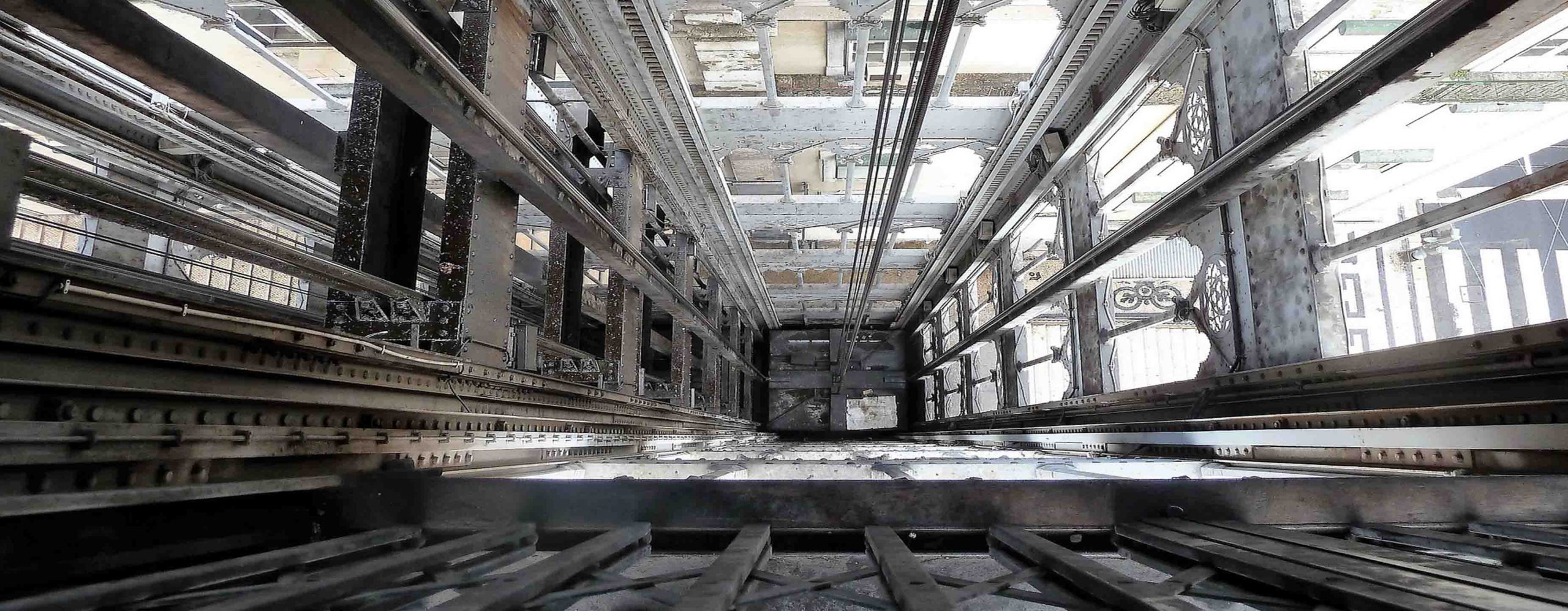
It is a tough chore deciding on what kind of elevator conveyance you should have in your next building project. As I have said before the elevator industry is very secretive about many aspect of vertical transportation. The wrong elevator is often placed in buildings because the information is guarded so closely. Too many resources can be spent on the improper type of elevator conveyance, not to mention the ongoing cost of maintenance and other factors if a bad fit is chosen. I hope to illuminate just some aspects of that decision in this blog, but let me warn you. Elevators are complex so I can’t cover everything in just one sitting. This will be a continuing series with this being the just the first.
Let’s start with the basics. There are three types of elevator conveyance systems (ways the elevator moves). This is regardless of the cab size or capacity of a commercial quality elevator. I am purposely excluding home elevators from this discussion, however there is a lot of transferable knowledge so stick with me. Any cab or weight capacity can utilize any of the three modes of movement. Those three are traction, hydraulic and roped hydraulic.
Traction is the type of conveyance that most people imagine when they think about elevators. It is the one from the movies with the ropes that people are constantly dangling from. Though the term “ropes” can be a little misleading. Here we go again with the elevator industry using terms that can confuse. Ropes are not what cowpokes use to lasso cattle or magicians use to tie up all too willing assistants. Ropes are actually cables. Elevator professionals understand ropes as highly engineered strands of wire wrapped together. A typical cable or rope can have over 150 strands of wire designed to be strong and flexible for a long time.
Ropes fill the hoistway of a traction elevator. That is because although one rope and pulley could in theory lift an elevator car, it would be inefficient and unsafe. So, in the hoistway you will find several hoisting ropes attached to the car and the counter weights. If you were paying attention in sixth grade science class and learned about pulleys and multiplication of force, you know why. Ropes are also redundant for safety.
Then there is a governor rope used to stop the car if there is a failure. If the elevator starts traveling too fast, the governor rope’s movement tells the brakes to stop the car. Lastly there are compensating ropes. Ropes can get heavy (up to 1.85 pounds per foot). Compensating ropes are attached to the car and counterweights to make up for the weight difference. All these ropes and sheaves (really pulley wheels) raise and lower the car.
However, despite appearing with Bruce Willis, Keanu Reeves and Spiderman (see the link at the end for a fun video on elevators in movies) traction elevators may be a star but, is not the the most common type of elevator conveyance. This is due to the attributes that make this type of elevator more conducive to taller buildings. As there are more low-rise or short buildings than high-rise buildings, hydraulic is much more common.
Hydraulic elevators are simply one or two hydraulic jacks pushing the elevator car up in the hoistway and then releasing hydraulic fluid to allow it to move down.
The jacks can either be in-ground or above-ground, depending on how high you need the elevator to go. But think about what a hydraulic jack is. In simplest terms it is a cylinder with a piston inside. As you push hydraulic fluid in, the piston goes up. So if you want to move something up ten feet you have to have a piston at least that tall. This means the whole jack must be at least that tall as well. Hence the in-ground jack.
An in-ground jack configuration is a single jack usually attached directly to the bottom of the elevator car. So to increase the height the car can travel, a taller jack must be used and must then be placed in a hole. The travel distance of the elevator dictates the depth of the hole.
Above-ground jacks (as you can tell by the name) are not in a hole. They are usually two jacks at the bottom of the elevator pit (the area at the bottom of the shaft) and attached above the car on either side, or more properly attached to the car’s sling several feet above the car itself on stiles. Logically, the higher the travel distance – the taller the jacks – the higher above the car the jacks must be attached – the taller the hoistway must be to accommodate the system. You may want to re-read that again. I wrote it and had to peruse it several times to make sure it was right.
In any case, to reduce the need of a real deep hole or a real tall hoistway, jacks can be and often are telescopic. Elevators can typically have up to four-stage telescopic jacks. This ultimately increases the useful range of hydraulic elevators overall.
Lastly, roped hydraulic elevators borrow from both systems. Again keeping it simple, this system of elevator conveyance uses hydraulic jacks, not to push the elevator car up directly, but to push an elevator sheave or pulley up that then with ropes raises the car.
How does it work? It has a pulley wheel or sheave mounted at the top of the piston or pistons and instead of it being directly connected to the bottom of the car or above the car on the sling. The sheave goes up or down as the jack is raised or lowered. A rope goes over the sheave and then is anchored to the hoistway below the lowest level of the piston and to the car.
There are clear benefits to this type of elevator, the most important being the 2:1 ratio of car to jack movement created by the use of sheaves and ropes. This provides a greater range of travel and allows for a shorter jack. Because shorter jacks are used greater travel distances can be achieved without an in-ground jack with its associated drilling costs. Also the travel speed is faster than hydraulic elevator at 200+ feet per minute, but the travel distance can easily be over 80 feet as the ropes and sheaves double the effective length of the jacks.
Your head maybe spinning a bit, especially if you generally view elevators as an annoyance that should be avoided at all costs. But, the above can help you start getting a picture of what type of elevator conveyance should be used in a project based on total travel. And let’s face it, cost and travel are the primary factors. Other factors may include speed, design flexibility and even building codes, but nothing can disqualify an elevator type faster than the practical inability for the elevator to travel the needed distance.
Regarding the cost briefly there are several factors to consider. The initial investment, work space interruption, the value of taking the elevator off the critical path, maintenance contracts and even operating costs. We will explore each of these in future posts, but again to keep it simple. Traction elevators are far and away the most expensive to buy and maintain. Roped hydraulic is next and finally the workhorse of the industry hydraulic is the least expensive. You must however, consider overall travel capabilities when deciding on your elevator. Take a look at the chart below.
The chart is for general guidelines. But as you can see the right elevator conveyance choice starts to take shape. For instance, for a two or three stop elevator, traction can be used but is highly impractical. There is simply no valid benefit for a traction elevator at that height. Likewise, an above-ground or holeless hydraulic elevator maybe less expensive, but impractical terms the limit is less than 30 feet. Also keep in mind that just because you can, does not mean you should. There are massive in-ground single stage hydraulic jacks. But, at the upper end it can get expensive, not only for the jack, but for drilling to nearly China.
So with all that said, hopefully you have a better understanding of the various ways an elevator moves and can start making clearer decisions on which should be employed in your next project whether you use Modular Elevator Manufacturing or not. If you would like a deeper conversation about what would be the best for your project, give us a call or get a fast track number by clicking the button below. We are looking forward to speaking with you.
By the way here is that fun video about the movies and elevators I promised click here.

I usually spend hours, if not days, uncovering research about elevators and looking for interesting and useful facts and figures to post in my blog. I research, work and write several times a month hoping to enlighten the reader and maybe make you think or at least smile. I really like doing that because I know elevators are a very interesting subject; so simple yet complex and full of fun details that fascinate.
Also, those in the elevator industry love to gather information and pass it on so I have a great, knowledgeable audience. This combination of smart people and facts can lead to new perspectives or different ways of thinking about the largest moving object in a building.
I also love uncovering the history of elevators, the modular business, construction and manufacturing as subject matter or as a springboard into the elevator industry. But, every once in a while someone does it a little bit better than I do. So rather than trying to copy what was done, it would be better to just post it as is. Below is one such example of a short, concise history that is better than I could have cobbled together.
You can quibble with some of the details if you are in an argumentative mood or choose to believe the romanticized version of the Otis legend, but on the whole this video, although abbreviated, is well researched and correct. The History Guy does a great job in all the videos he produces and I would recommend you poke around a bit on his YouTube page after you watch the video about your favorite mode of vertical transportation. You will find something that interests you for sure.
The video is informative and the format is designed for a broad audience so it is kept short, and as a result the History Guy did not have the time to get in depth about the future of vertical transportation. And as we all know for any low or mid-rise building modular elevators are the future.
If you want more information on that or would like to see one placed you can watch our YouTube video too. Really a fully installed elevator in a couple of hours???? Absolutely true and astounding to see.
Of course for more info you can click the button below and get a Fast Track quote on how much a modular unit would be for your next project. You can also contact us any time for information about MEM or modular elevators.
We have a pretty interesting history too…”A history that deserves to be remembered!”

